Definition & Assessment
A successful custom battery program begins with disciplined questions. YC works with your engineering and sourcing teams to clarify the application, translate operating demands into measurable requirements, and expose technical risks before architecture decisions become expensive to change.
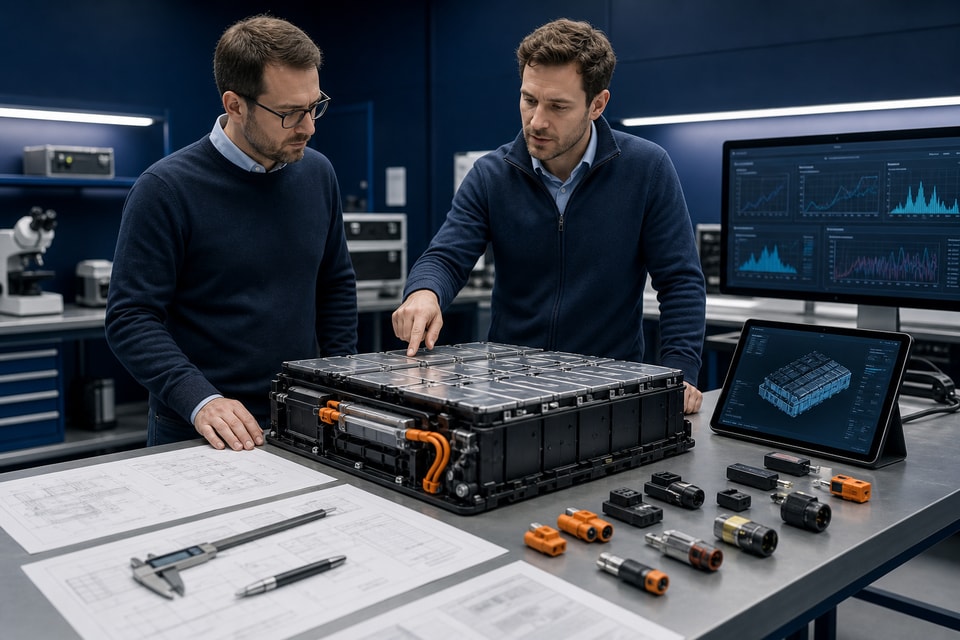
Project understanding
We establish a common technical baseline around the product, user environment and business intent. The discussion covers load profiles, peak and continuous power, runtime expectations, charging behavior, installation space, weight priorities, duty cycle, storage, service conditions and expected lifecycle. We also identify market and application requirements that could influence materials, labeling, documentation or testing. By separating firm constraints from preferences and open assumptions, the team can make decisions against a traceable requirement set rather than disconnected inputs.
Technical assessment & system architecture
YC evaluates how cell chemistry, electrical configuration and protection strategy fit the application. Assessment includes nominal and operating voltage, capacity and power demand, BMS functions, charge and discharge limits, communications, connectors and host interfaces. Mechanical envelope, enclosure concept, sealing needs, thermal paths, mounting and service access are reviewed as one system. The result is an architecture direction that balances performance, manufacturability and integration, while clearly recording interfaces and assumptions that require customer confirmation or later validation.
Risk-focused output
The assessment is converted into useful engineering outputs: preliminary electrical and mechanical specifications, operating conditions, chemistry and cell-format rationale, BMS and interface expectations, enclosure and thermal considerations, and a list of unresolved risks. Lifecycle goals, intended market requirements and verification priorities are connected to the design inputs. This creates a controlled handover into development, gives both teams a practical basis for trade-offs, and helps prevent hidden assumptions from becoming late design changes or avoidable validation issues.
Bring your application, constraints and open questions.

Jiangsu Yongchang New Energy Technology Co., Ltd. and Shanghai YC Electrotech Co., Ltd. deliver certified lithium battery solutions backed by 15 years of experience, a 30,000 m² manufacturing base and exports to 100+ countries and regions.
NAVIGATION
CERTIFICATIONS
- CE & CCC
- IEC 62133 & GB/T 28164
- UN38.3 & MSDS
- RoHS, CB & REACH
CONTACT US
- Gaoqiao, Houxian, Danbei Town, Danyang City, Jiangsu Province 212300, China
- Tel: +86 511 8639 1768
+86 189 5282 5827
+86 189 1283 8663 - Email: contact@yc-batteries.com
- Web: www.yc-batteries.com