Laboratory Testing & Quality Management
Ensure comprehensive quality control from individual cells to complete battery packs. Based on rigorous safety standards like GB/T47741-2026, our testing matrix pushes the limits of battery reliability under extreme environmental, mechanical, and electrical stress.
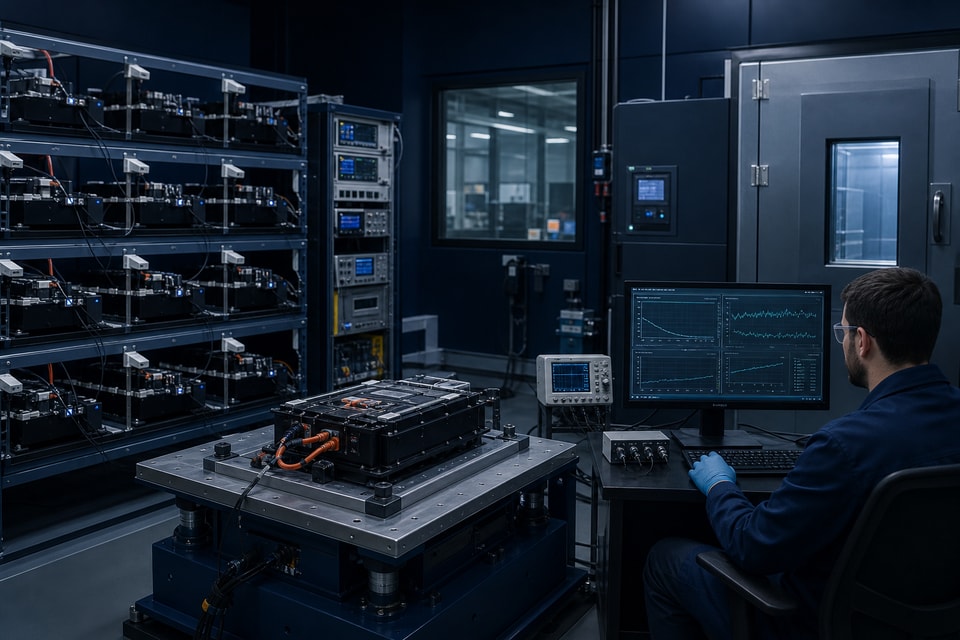
Cell Testing (GB/T47741-2026)
Comprehensive evaluation at the cell level ensures baseline safety and performance under abusive conditions. Core tests include:
- High-Temperature External Short Circuit
- Overcharge & Forced Discharge
- Low Pressure
- Temperature Cycling
- Vibration & Shock
- Drop, Impact & Crush
- Thermal Abuse
- Nail Penetration
- Lithium Plating
- Thermal Runaway
- Cycle Life
Acceptance Criteria: Tested cells must show no disassembly, no rupture, no fire, no explosion, and maintain targeted capacity retention based on standard requirements.
Battery Pack Testing (GB/T47741-2026)
At the system level, testing focuses on environmental durability and electrical protection mechanisms. Key procedures include:
- Low Pressure & Temperature Cycling
- Vibration, Shock & Drop
- Stress Relief
- Salt Water Immersion
- Flammability Requirement (V-0)
- Overvoltage / Overcurrent Charging
- BMS Mutual Recognition
- Undervoltage / Overcurrent Protection
- External Short Circuit
- Reverse Polarity Protection
- High / Low Temperature Protection
System Validation: Ensures the Battery Management System (BMS) and physical enclosure consistently safeguard against faults and harsh environments.
The test matrix depends on application risks, relevant standards, sample configuration and the agreed program timeline.
Build reliability evidence around real operating demands.

Jiangsu Yongchang New Energy Technology Co., Ltd. and Shanghai YC Electrotech Co., Ltd. deliver certified lithium battery solutions backed by 15 years of experience, a 30,000 m² manufacturing base and exports to 100+ countries and regions.
NAVIGATION
CERTIFICATIONS
- CE & CCC
- IEC 62133 & GB/T 28164
- UN38.3 & MSDS
- RoHS, CB & REACH
CONTACT US
- Gaoqiao, Houxian, Danbei Town, Danyang City, Jiangsu Province 212300, China
- Tel: +86 511 8639 1768
+86 189 5282 5827
+86 189 1283 8663 - Email: contact@yc-batteries.com
- Web: www.yc-batteries.com