Verification & Validation
Verification asks whether the battery was built to its requirements; validation asks whether it performs correctly in the intended application. YC connects both questions through a risk-based plan, selecting evidence that reflects system architecture, operating conditions, interfaces and the consequences of failure.
Design verification
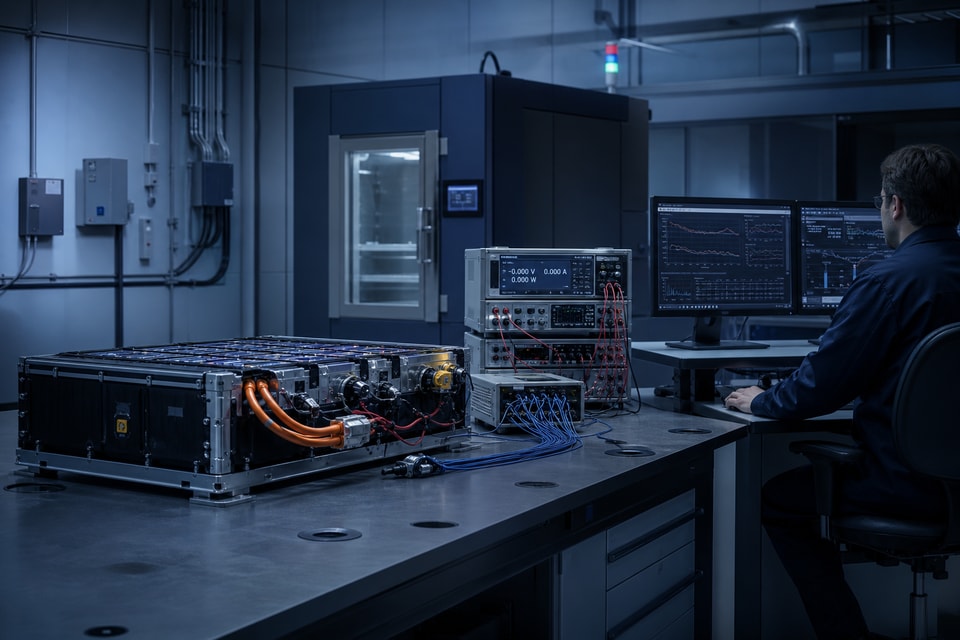
The verification plan traces tests and reviews to agreed design inputs. Depending on identified risks, work may address electrical protection thresholds, short-circuit and overcurrent responses, charge and discharge behavior, capacity, power delivery, temperature rise, sensing accuracy and communications. Mechanical dimensions, mounting, insulation, enclosure behavior and selected environmental stresses are checked where relevant. Methods, acceptance criteria, samples and configurations are documented so results can be interpreted against the intended design rather than treated as isolated laboratory observations.
Application validation
A battery can satisfy component-level checks yet behave differently inside the host product. Validation therefore considers representative loads, charger interaction, installation, airflow, communications, user modes and fault handling in the application context. YC works with the customer to identify realistic operating scenarios and boundary conditions, then selects practical evidence for runtime, power response, temperature, mechanical integration and system behavior. The scope is tailored to application risk and available prototypes rather than applying the same checklist to every battery program.
Issue closure
Test findings are classified, investigated and connected to requirements, design records and sample configuration. YC supports containment, root-cause analysis, corrective design or process action, and targeted retesting to confirm closure. Electrical, thermal, mechanical, environmental or communication issues are reviewed for related risks instead of being fixed narrowly. The resulting evidence provides a clearer decision basis for design release, certification planning or pilot production, while unresolved items remain visible with owners and next actions.
Plan verification around your application and highest risks.

Jiangsu Yongchang New Energy Technology Co., Ltd. and Shanghai YC Electrotech Co., Ltd. deliver certified lithium battery solutions backed by 15 years of experience, a 30,000 m² manufacturing base and exports to 100+ countries and regions.
NAVIGATION
CERTIFICATIONS
- CE & CCC
- IEC 62133 & GB/T 28164
- UN38.3 & MSDS
- RoHS, CB & REACH
CONTACT US
- Gaoqiao, Houxian, Danbei Town, Danyang City, Jiangsu Province 212300, China
- Tel: +86 511 8639 1768
+86 189 5282 5827
+86 189 1283 8663 - Email: contact@yc-batteries.com
- Web: www.yc-batteries.com